
Skip to content

Where to apply AI, and in what order

The hard part is not the tools. It is knowing which parts of the business are worth changing, and what to leave alone. We work that out from your own evidence and hand back a roadmap ranked by business value.

Request a Callback
3,200+
Australians Trained
150
Organisations Served
5.0
Google Rating
Six example AI use cases ordered by the business value each returns, with the HR chatbot marked as one to deferEXAMPLE AI USE-CASES BY BUSINESS VALUERFP, tender and quote automationProposal and price draftingContract generationManagement reportingData warehouseHR chatbotDEFER
Illustrative. Your roadmap is built from your own evidence.

AIRE's advisory work tells a leadership team where AI belongs and in what order: a 90-minute AI use case session, a readiness diagnostic, AI strategy and governance written against the Privacy Act 1988, the ACSC Essential Eight and your industry's own obligations, enterprise architecture, and a full nine-step review. Every engagement ends in a roadmap ranked by business value.

How we work it out

Four phases, nine steps, and AI does not appear until the seventh

Most AI advice starts by asking where AI could go. That is the wrong end. This starts with how the business makes money and where it is losing time, and only asks the AI question once the problem has been defined three different ways. What comes out is a roadmap of AI, technology and process changes ranked by the value each one returns. It works the same for a twenty-person practice and a listed operator; the evidence changes, the sequence does not.

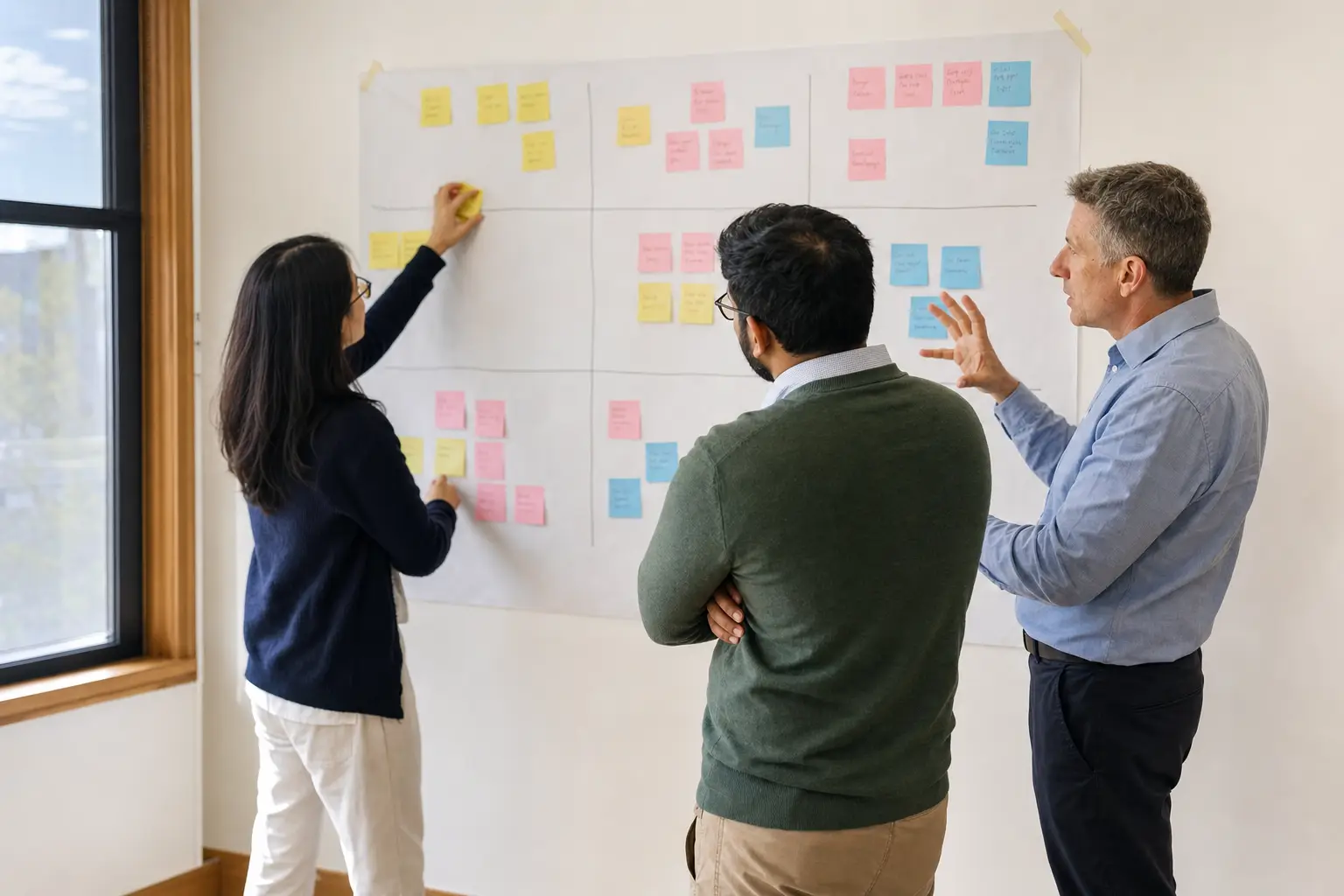
A leadership team mapping their business model onto a nine-panel canvas on the wall
  1. Frame

    What the business is actually for, before anyone proposes anything.

    Business model canvas

    How the organisation makes and keeps money, across all nine panels. Most leadership teams have never seen theirs written down in one place, and the disagreements that surface here are the useful part.

    Strategic goals

    Three to seven prioritised outcomes with key results attached. Everything downstream traces back to these, which is what stops the roadmap becoming a wish list.

  2. Diagnose

    Where it is losing time, trust and money. Evidence, not opinion.

    Business capabilities

    What the organisation is genuinely good at, rated one to five against how much each capability matters. The gap between importance and competence is where the work is.

    Stakeholder journeys

    The customer, the employee and the partner experience mapped end to end, which surfaces the pain that never reaches a ticket queue and therefore never reaches a strategy deck.

    Application architecture

    The technology estate as it actually is, with what each system costs and where it sits in its life. Usually the first time anyone has totalled it.

  3. Solve

    Design the fix. Then, and only then, ask whether AI belongs in it.

    Solutions

    Interventions designed against the goals and the pain, across people, process and technology. Plenty of them turn out to need no AI at all, and saying so is the point.

    AI use cases

    Now the AI question. Each candidate is classified as a quick win, a foundational enabler, a strategic pilot or a defer, and defer is a real answer. Candidates are drawn from your own evidence and every one is validated by a person before it survives.

  4. Commit

    An order of work, and a number the board can hold you to.

    Roadmap

    Sequenced quarter by quarter across parallel lanes, with the constraints stated rather than assumed away. This is the answer to “in what order”.

    Business case

    NPV and ROI, each line traceable back to a strategic goal from phase one. If a piece of work cannot be traced, it does not go in.

Four colleagues at a wall-sized roadmap, arguing about what belongs in which quarter

AI is not a strategy. It is one of the things you might use once you know what the strategy is, which is why it sits at step seven of nine rather than at the front.

The work

What each piece of advisory work delivers

Each card above opens here, with what the work is and what you get at the end of it. The people who do it will tell you what to leave alone as readily as what to start.

A 90-minute facilitated session, followed 48 hours later by a roadmap and recommendations90 minutesIn the room, facilitated48 hoursRoadmap in your inbox

The AI use case ideation session

Ninety minutes with your leadership team, facilitated by us. It is use case discovery done properly: how the business makes money, where the time goes, and which of the ideas people already have would actually pay. Nobody is asked to arrive with a list of use cases, and nobody leaves with a vendor shortlist.

Forty-eight hours later you have a roadmap and a set of recommendations, ranked by the business value each one returns. Some will be AI. Some will be a process fix or a system you already own used properly. Each one says what it is worth and what it would take, so the leadership team can decide what to fund first.

It is one of the most requested pieces of advisory work we run, because it is the fastest way to get from a room full of opinions to an order of work.

  • A facilitated 90-minute session
  • A roadmap within 48 hours
  • Recommendations ranked by business value
  • AI and non-AI changes side by side

A roadmap in your inbox 48 hours after the session.

What to back this year, what waits, and the one-page rule underneath bothBACK NOWCopilot rolloutProposal draftingNOT YETCustom agentsPlatform migrationOne page, one ruleWhat may go into a prompt
Illustrative.

AI strategy and governance

An AI strategy earns the name when it says what to stop as clearly as what to start. Ours is built from the goals the business already holds, and names the few things worth backing this year, in order, and what can wait.

Without a written rule, the cautious teams ban the tools and the confident ones paste freely. Most organisations have either no rule at all or forty pages from a global framework that exist to be pointed at rather than used. Either way the tools stay banned until the policy is finished, and the policy is never finished.

The governance work gives your organisation one rule, written against the Privacy Act 1988, the ACSC Essential Eight and your industry's own obligations, that people can actually follow. Which plan to run on each tool, with SSO, admin controls and retention set so your security team will pass it. A one-page data-handling rule: what may go into a prompt, what may not, and what to do when it is unclear. And a position your board, your auditors and your CIO can all put their name to.

A draft lands within a week and is tested with the people who have to follow it until the cautious and the confident read it the same way. It is not a compliance certification, and we do not claim one.

  • What to back this year, and in what order
  • Plans and settings your security team will pass
  • A one-page data-handling rule
  • A position the board can sign

A strategy and a rule your board can sign.

Four business capabilities scored one to five today, each marked with how much it mattersCAPABILITY TODAYClient deliveryQuote to cashReportingMarketingtodayhow much it matters
Illustrative.

Enterprise architecture

Most roadmaps are drawn on top of an estate nobody has looked at in years. The capability map is out of date, the application list lives in three spreadsheets, and nobody has added up what the systems cost. So the recommendations assume things that are not true, and the first project finds out the hard way.

We map it as it is: the capabilities the business runs on, rated against how much each one matters, the applications behind them with what they cost and where they sit in their life, and where the data actually lives. That shows where a new tool would help, where an existing one is paid for and unused, and where the real fix is retiring something rather than adding to it.

It stands on its own, and it is also the Diagnose phase of the full review below.

  • A business capability map, scored
  • The application estate, with costs
  • Where to consolidate, retire or invest
  • A target state the roadmap can build to

A map of the estate as it is, not as the diagram says.

A four-step workflow, read, decide, act and check, with a person approving before the step that reaches a customerFROM THE PROCESS WE MAPPEDReadDecideActA personCheckNarrow, observable, stoppable

Agentic workflows, designed from the evidence

Once the review has found and analysed a process, we can design and build the agentic workflow that runs it. That order matters. A workflow built from a real process map, with the volumes, the exceptions and the people who handle them written down, does the job. One built from a demo does the demo.

Each workflow is narrow, observable and stoppable, with a person checking anything that commits money or reaches a customer. It is built on what you already run where that will do, and on the platform that suits the work where it will not. You own it when we leave.

  • A workflow design from the analysed process
  • Human checkpoints where they matter
  • The build, tested on your own cases
  • Handover to the team that will run it

A workflow built from your process, not a demo.

It ends in a decision, not a deck

Most AI advice fails in the same way: it produces a document. A roadmap nobody funds, a maturity score nobody acts on, a list of use cases with no order to them. The engagement ends and the organisation is exactly where it started, several months poorer.

Every engagement here ends in a roadmap of business value: what to do, in what order, and what each step is worth. It covers AI, other technology and plain process change, because the best fix is often not AI at all. Senior operators do the work, and the roadmap is yours to take to whoever you like.

FAQ

Frequently Asked Questions

The other two lines

Training

Hands-on sessions on ChatGPT, Claude, Copilot and Gemini, on your own documents.

Build

Platform implementation and custom applications, handed over working.

Clients we have worked with

  • NSW Health
  • UNSW Sydney
  • ASICS
  • NEXTDC
  • Homecorp
  • Spirits Platform
  • Wests
  • NICE

Ready to talk?

Three ways to start a conversation

Pick whichever suits you. Every path goes to the same small team.

We respect your privacy. Your details are used only to call you back about your enquiry.

Prefer to chat now?

Our AI assistant qualifies and books in under 90 seconds.

Call us directly

Mon to Thu, 9am to 5pm AEST.

+61 2 5300 5007

No obligation. We won't add you to a marketing list.

A straight read on where your organisation actually is

Book a free 30-minute call. You will get an honest view of what is worth doing first, what it would cost, and whether the use case session or the full review suits you. No deck, no pitch.

No obligation. No sales pitch. If we cannot see clear value for your team, we will tell you.