Insight
The everyday work businesses want AI to improve
By Brett Raven, APAC Lead & Board Member, AIREPublished
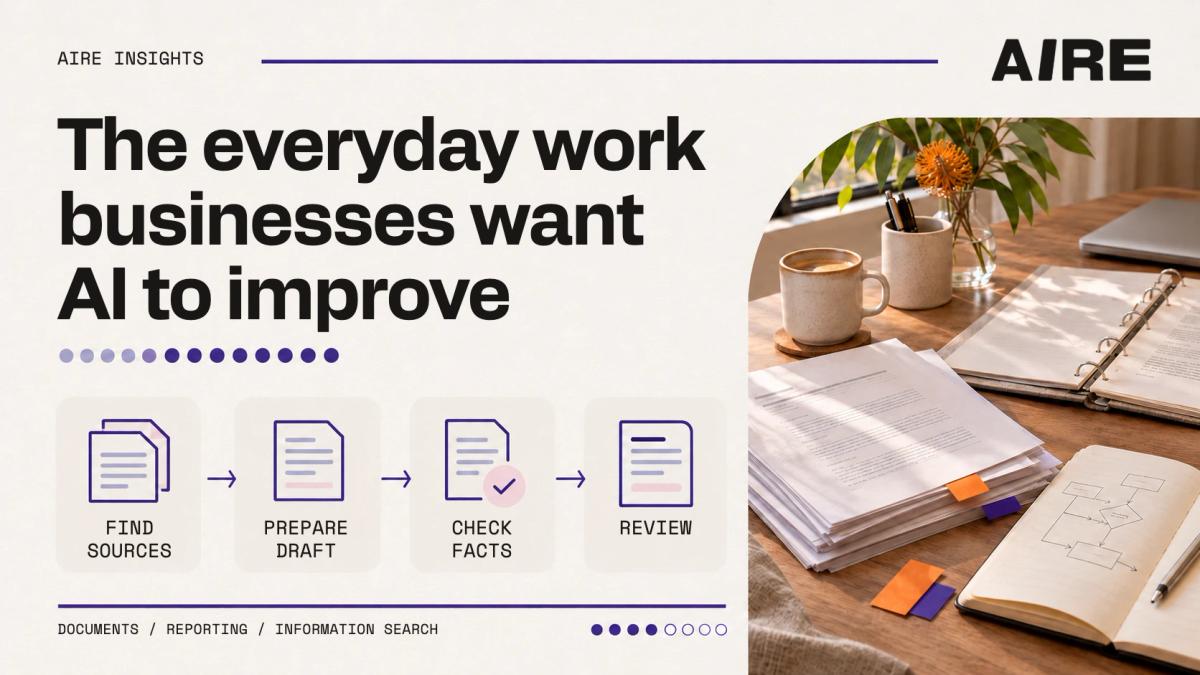
Our 2,000+ pre-workshop survey responses and our client conversations point to four kinds of everyday work: preparing documents from information you already hold, comparing records to find exceptions, finding reliable answers across internal sources, and turning recurring information into reports. Pick one, define its source, finished output, reviewer and measure before choosing a tool, and judge it on the whole task, including the checking that remains.
What changes
A proposal still needs pricing checked. A board report still needs information gathered from several systems. A service team still needs to find the right procedure before answering a question. Those are useful places to start a conversation about AI.
Across our pre-workshop surveys and client discussions, people describe work they already understand. They know which documents take too long, where information gets lost, and which reports start with another round of copying and pasting. The practical question is what would make that work easier to complete and easier to trust.
By an AI workflow, we mean one recurring task with defined inputs, approved sources, a finished output and a named reviewer, where AI handles some of the steps and people keep the decisions.
- Recurring document work, information search, reconciliation and reporting give you concrete workflows to examine.
- A faster first draft can leave the difficult checking and handoffs untouched.
- Define the source, finished output, reviewer and measure before choosing a tool.
- Count the time left for checking, correction and maintenance when judging the result.
Listen to the task people describe
We ask workshop participants about their work before we teach the tools. Their answers help us choose examples that matter to them.
A request for help with proposals can involve several jobs. Find a relevant previous proposal. Gather the current requirements. Draft the response. Check pricing. Transfer the information into the proposal system. Get approval.
An AI assistant may help with drafting. The person doing the work can still face the same search, checking and administration afterwards. That distinction matters when you choose an AI workflow: map the whole task before deciding which part to change.
Our wider pre-workshop survey programme has collected 2,000+ response records. The four themes below come from a targeted internal research review and selected client conversations, rather than a fresh analysis of every response. They are starting points for discovery, not a ranking of every business problem.
Four kinds of work worth examining
Preparing documents from information you already hold
People describe gathering existing material to produce a new document: a proposal, a board paper, a staff CV or a routine report. One request in our research involved taking project information from timesheet reports and updating staff CVs. The finished document still needed the staff member's review.
That is a much clearer starting point than asking for a general writing assistant. The inputs are identifiable, the output has a recognisable structure, and someone can say whether it is correct. A useful first version could prepare a draft from approved sources, preserve the template and flag missing details, leaving professional judgement and approval with the reviewer.
Comparing records and finding exceptions
Other requests centre on checking one set of records against another: supplier invoices, delivery dockets or summaries exported from a business system. The value comes from directing a person's attention to differences that need investigation. The workflow needs agreed matching rules and a clear way to tell missing information from a genuine discrepancy.
This does not automatically require a free-running AI agent. Straightforward rules may handle the matching, and AI can be considered where interpreting inconsistent text adds value. Our AI agents explainer covers the difference between a defined workflow and a more autonomous system.
Finding reliable answers across internal sources
Some questions take too long because the answer is spread across a help centre, internal procedures and operational records. Putting a chat interface in front of those sources does not settle which version is current or which rule takes priority.
A useful internal assistant needs a defined source set and permission boundaries. It should show where an answer came from, and when the sources disagree or do not answer the question, it needs a route to someone who can resolve it. Maintaining the sources is part of the business problem, and that work remains after the interface is built.
Turning recurring information into a report people can act on
Reporting requests often start with information already collected elsewhere. Someone exports it, selects the relevant parts and assembles an update. One discovery conversation described an executive assistant manually gathering highlights into a board report. Another survey request paired automated reporting with a clear requirement: the figures had to be trustworthy.
The useful output is a report a reviewer can trace back to its inputs. It should distinguish a recorded fact from an interpretation, and identify information that needs checking.
| Recurring need | A bounded first version | What to measure |
|---|---|---|
| Document preparation | One document type, using approved sources and a template | Preparation time and correction effort |
| Reconciliation | One pair of files and agreed matching rules | Checking time, missed issues and false alarms |
| Internal knowledge | One department's maintained sources | Answer accuracy, time to answer and unresolved questions |
| Reporting | One existing report, with traceable figures | Preparation time, corrections and usefulness to the reader |
These are starting scopes drawn from the research. They are not claims about systems we have delivered or savings already achieved.
Accuracy belongs in the workflow
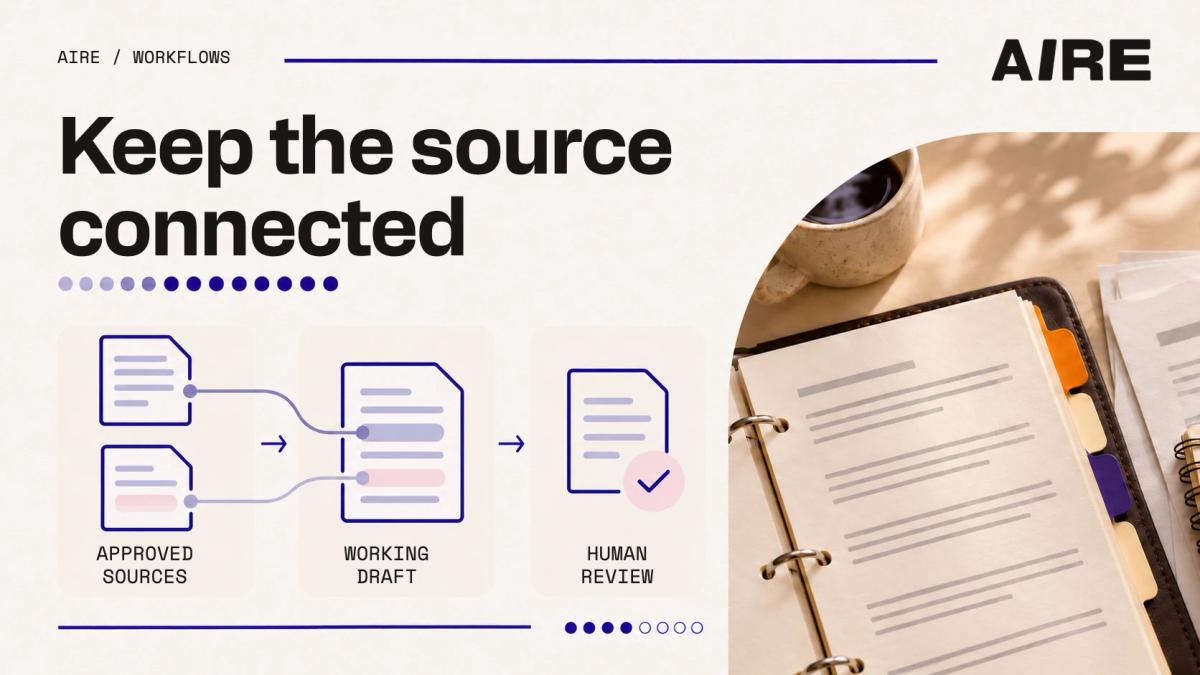
Accuracy and confidentiality appear in the research alongside requests for more useful outputs. They need to shape the work from the beginning. For a document workflow, decide what happens when a source is missing. For reporting, decide how a reviewer checks a figure. For an internal assistant, decide what it can access.
The Office of the Australian Information Commissioner recommends assessing an AI product's suitability, privacy risks and oversight before adopting it, and its guidance also addresses verifying personal information that AI generates (OAIC, 2024).
Those decisions help make a workflow usable. Design the review so people can check material facts without recreating the whole task.
Training helps people identify the next problem
A workshop can give someone the vocabulary to describe what they want to change. They can move from asking about an agent to identifying the actual work: inputs, decisions, handoffs and outputs.
That is a useful discovery opportunity. It does not establish that every request needs a custom build. Sometimes the next step is better use of an existing tool. Sometimes the process needs clarification. Sometimes a focused automation is justified.
The person who spots the opportunity may also need help bringing the right colleagues into the decision. The process owner can validate the output. A systems owner can authorise access. A sponsor can decide whether the investment makes sense.
Our AI training for teams develops practical use on real work. The next step depends on what the team needs to make that use repeatable.
Measure the finished work
A draft produced quickly is one part of the result. Someone may still spend time checking facts, fixing structure and moving information into another system.
Measure the current task from start to finish. Then measure the proposed workflow, including the review that remains. Include the cost of the tools and the time needed to maintain templates, sources and rules. If a workflow releases capacity, decide how the team will use it. Released hours are not automatically cash savings.
The National AI Centre's implementation guidance puts testing, monitoring and accountability alongside the technical work. Those practices belong in the operating process (National AI Centre, 2025).
Choose one workflow you can describe clearly
Start with the work your team can explain in detail. Ask:
- What starts the task, and what counts as finished?
- Which inputs and approved sources does it need?
- What must never be guessed?
- Who checks the result, and what do they check it against?
- How will we know whether the whole task has improved?
For document work, our companion AI document automation guide turns those questions into a practical brief.
If you want help choosing the first workflow, our AI advisory work starts with your evidence and business priorities.
Not sure which workflow to start with? We'll look at the work your team repeats and help you pick a practical first one.
About this research
The examples in this article come from AIRE's internal review of pre-workshop survey responses and selected client conversations. The 2,000+ figure describes the wider survey programme, not the size of a newly analysed sample.
We report the themes qualitatively. This article does not present response-level percentages or a statistical analysis of every response in the wider collection.
Responses describe participants' needs and interests. They do not represent unique businesses, a representative survey of Australian businesses, or measured implementation outcomes. Client examples are paraphrased without names.
Research basis: AIRE pre-workshop survey programme; internal "Beyond training: from discovery to delivery" review, 6 November 2026; client discovery and workshop conversations.
Frequently asked questions
What everyday work do businesses most want AI to improve?
In our pre-workshop surveys and client conversations, four kinds of work come up again and again: preparing documents from information the business already holds, comparing records to find exceptions, finding reliable answers across internal sources, and turning recurring information into reports people can act on.
Do we need an AI agent to automate this kind of work?
Not usually for a first version. Straightforward rules can often handle matching and calculations, and a defined workflow with a person reviewing the output is easier to test and trust. Consider AI where it adds value, such as interpreting inconsistent text or drafting from approved sources.
How should we measure whether an AI workflow is worth it?
Measure the whole task before and after, not just how fast the first draft appears. Include checking, corrections, moving information between systems, tool costs and the time to maintain templates and sources. Released hours are capacity, not automatic cash savings.
Where does the 2,000+ survey figure come from?
It is the total number of responses collected in AIRE's wider pre-workshop survey programme. The themes in this article come from a targeted internal review of those responses and selected client conversations, not a statistical analysis of every response.
Sources
We read each public source on the date shown beside it. The survey programme and client conversations are AIRE's own research, described in About this research above.
- Office of the Australian Information Commissioner, Guidance on privacy and the use of commercially available AI products (21 October 2024, updated 17 January 2025). Read 12 November 2026.
- National AI Centre, Guidance for AI adoption: implementation guidance. Read 12 November 2026.